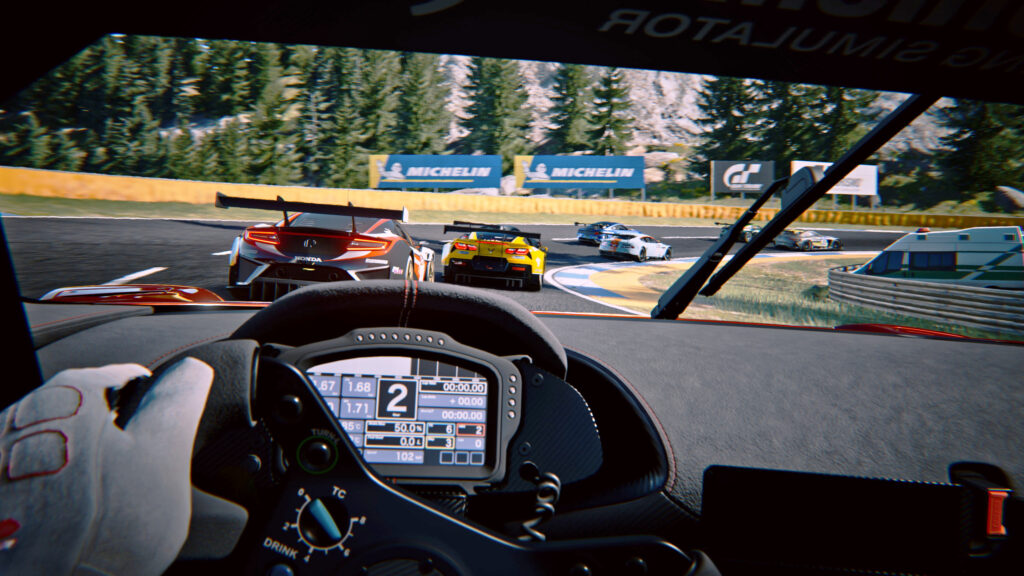
You tighten the halo strap, lower the visor, and the living room vanishes.
Suddenly, you aren’t sitting in a rig looking at a display panel—you are strapped into the carbon-fiber tub of a GT3 machine sitting on the grid at Spa-Francorchamps. Glance left, and the roll cage weld seams catch the early morning mist. Look down, and your virtual hands mirror your direct drive rim perfectly. Behind you, the twin-turbo V8 idles with a low-frequency hum.
When the lights go out, everything you thought you knew about sim racing spatial awareness gets completely rewritten.
1. True 1:1 Scale and Depth Perception
On a flat monitor—even a massive 49-inch ultrawide—your brain has to translate 2D images into artificial perspective lines. You end up judging braking markers by memorizing screen pixels and trackside signs relative to a static camera angle.
In virtual reality, stereoscopic 3D provides authentic biological depth. Plunging down into Eau Rouge or dropping through the Corkscrew at Laguna Seca is no longer just watching elevation change on a screen; your vestibular sense anticipates the compression. You can spot your braking marker, look past the apex curb, and gauge closing speeds against rival bumpers with pinpoint accuracy.
2. Looking Through the Corner
Real drivers never stare dead-ahead at the hood—their eyes naturally track where they want the car to go.
- Natural Head Tracking: As you trail off the brakes and commit to turn-in, your head naturally rotates to look directly down the circuit, spotting track limits and exits far earlier than any fixed camera allows.
- Side-by-Side Dogfights: When defending into Turn 1, a split-second head turn lets you track a car sitting right in your blind spot or check your side mirror instinctively. Radar overlays become secondary—your eyes do the heavy lifting.
3. OLED Contrast, HDR, and Eye-Tracked Precision
The technical backbone inside the PSVR2 elevates Polyphony Digital’s lighting engine to an entirely different tier:
- OLED HDR Panels: Punching out of a dark tunnel into blinding midday sun causes you to squint. Night racing turns pitch-black outside the reach of your headlights, making endurance stints feel properly grueling.
- Foveated Rendering: Integrated eye-tracking sensors detect exactly where your pupils focus in milliseconds. The PS5 concentrates maximum graphical fidelity directly at your focal point while keeping framerates rock-solid across full grids.
- Headset Haptics: Subtle rumble motors in the headband transmit kerb strikes and turbulent buffeting directly through your skull, adding a tactile layer standard displays simply cannot replicate.
Flat Screen vs. PSVR2 Head-to-Head
| Feature | Single / Ultrawide Display | PSVR2 Headset Integration |
|---|---|---|
| Field of Interaction | Static window looking into the sim | Full 360° situational cockpit immersion |
| Braking & Turn-in | Pixel references & memorized visual cues | Natural stereoscopic depth & distance judgment |
| Blind Spots | Relies on radar UI or thumbstick camera pans | Natural head turns and functional side mirrors |
| Lighting Dynamics | Standard SDR/HDR screen brightness limits | Blinding HDR light peaks and true OLED blacks |
Once you spend twenty minutes wheel-to-wheel inside a cockpit that feels tangible enough to reach out and touch, going back to a flat screen feels like watching motorsport through a letterbox. It isn’t just an accessory for Gran Turismo 7—it fundamentally transforms how you drive.
Up Next: We’re breaking down our dialed-in PSVR2 settings, sweet-spot adjustments, and essential comfort mods for long-stint racing. Stay tuned.